

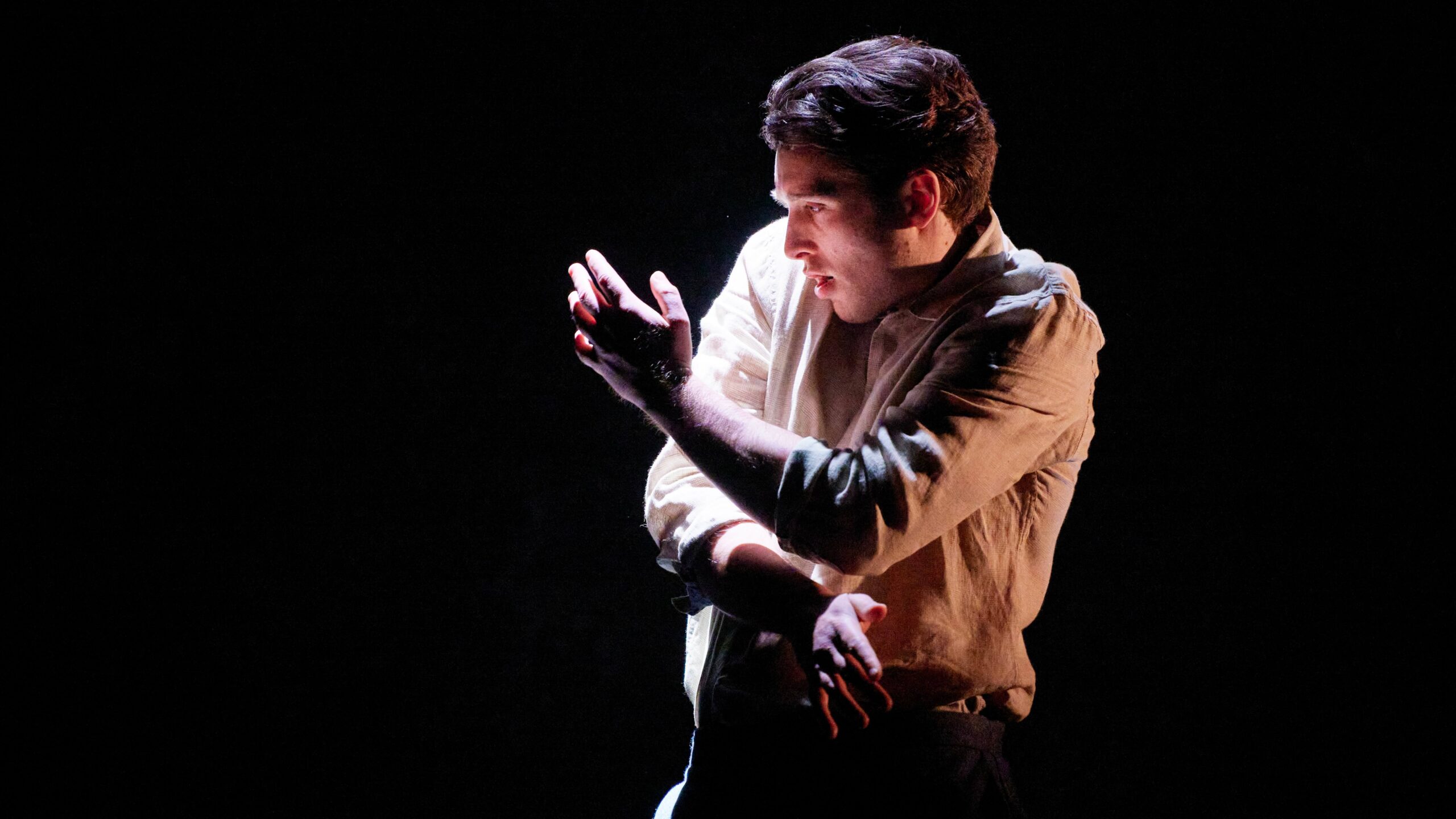
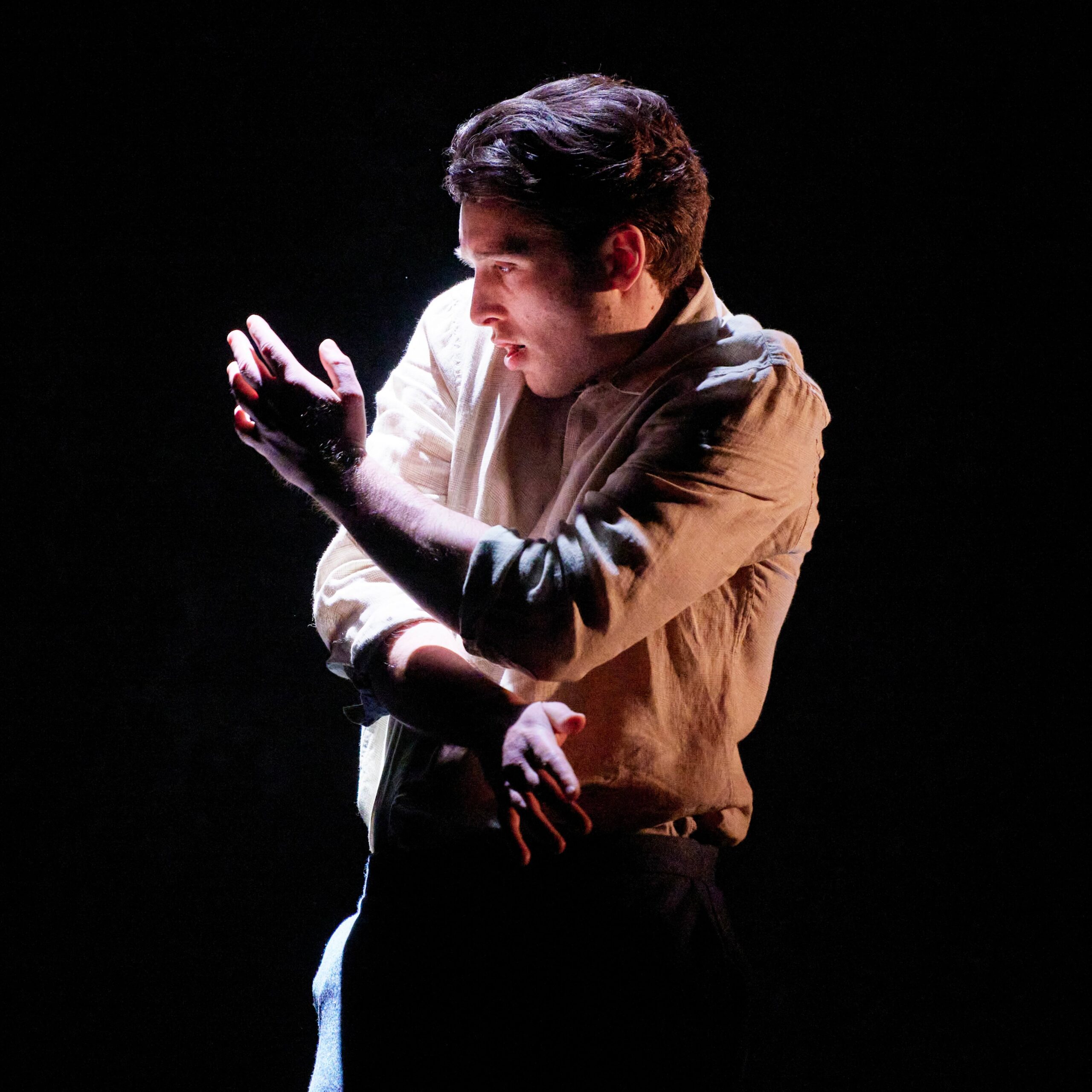
P.J. Mathews: Frank, here we are in the Abbey Theatre, which has a special place in your life, in your work. What does it feel like to be here in the Abbey now?
Frank McGuinness: It’s 44 years since The Factory Girls, it’s over 40 years since Sons of Ulster, so it’s a very strange feeling that I should be, really, approaching it like an auld fella. But for some reason, what happens in the Abbey is that it’s as if age disappears and you’re back to being the terrified, tongue-tied eejit, dealing with real experts, particularly in the acting fold. I was enormously lucky to be blessed with the presence of Maureen Toal, May Cluskey, those wonderful woman, mighty actors, a very young Martina Stanley, lovely Nuala Hayes, Patrick, Mason directed superbly, Kathleen Barrington, Peadar Lambe and Nicky Grennell. So those forces are still so much alive to me, so vibrant. That play is still the touchstone by which I have to judge everything else and all that happened with it. So coming into the Abbey to do a new play in the Peacock where I began, it really does call into, well, not call to question, but call into relief the whole history of my involvement in the stage and in the theatre. And I have always described myself as an Abbey playwright, that’s the one thing I would agree on more than any other description. So, it’s comforting and it’s challenging at the same time. But it is the building that I know, and it’s a building that I love, forever the best at times, and the most threatening at times as well.
P.J. Mathews: Yes, and as we’re here now, playing on the main stage is Sean O’Casey’s The Plough and the Stars, the centenary production, and that whole Abbey heritage … how does that sit with you?
Frank McGuinness: Well, The Plough is a particularly important play for me. I taught it for years with yourself in UCD, and I am constantly stunned by what revelations it still has for me after all these years. I think that it has an enormous impact on students still, and I think that impact is due to the sheer size of the play, the sheer ambition of it. I mean, you could, putting your academic hat on, argue that there’s actually four plays operating here. There aren’t, of course, there’s only one, but the great range and risk that O’Casey takes, make it an absolute delight to tackle. And I still look at it and The Cherry Orchard as probably the two mighty plays in the 20th century. And I’m very proud of the fact that it’s an Irishman has written one of them. He confronts the Irish writer with a questioning, a permanent questioning, of what is a play? How do you make a play? How do you cope with the politics of your era, the politics of other eras? How do you cope with history on stage? How do you deal with that? How do you make it theatrical? How do you never lose sight of the fact it is a play and The Plough is always an enormous comfort, an enormous challenge, but an enormous comfort to know that it’s there. He did it more in it than, I think, any other Irish play. That’s the one. So I’m delighted that he’s up above and I’m in the Peacock, and that’s a fair balance, as far as I am concerned, but I’m delighted that The Plough is on and that we’re going on in the Peacock.
P.J. Mathews: One of the great things about that play is that there’s so much in it. There’s so much politics in it, there’s so many ideas in it. There’s so many, if you want to go looking for them, so many messages in it. But they’re not overbearing. It’s a play, as you say, and that’s something that I see as a parallel with your own work, that the didactic, the message never comes first. It’s in there yet it’s possible to find yourself going down all sorts of channels of discovery within both O’Casey’s plays and your plays, but they’re never programmatic in that regard. And I always think of that great line from Synge when he said that you go to the theatre as if you’re going for a dinner, ‘where the food we need is taken with pleasure and excitement’, not like you’re going to a chemist shop for vitamins. And I always feel that what he’s saying there is that when the message is the first thing you see, there’s something lost in the theatrical experience.
Frank McGuinness: Yeah, you’re not doing it, you’re not doing the play. I mean, O’Casey is a great storyteller, particularly in The Plough where, I mean, with the amount of stories that are coming at you. That would preclude any attempt to preach, because it’s going to contradict … each story will contradict itself brilliantly. Could there be a more contradictory figure in Irish theatre than Bessie Burgess? … a Prod, but she’s working class. She’s pro-British, but she dies saving the wife of a 1916 hero. She articulates her own background and her own class with enormous conviction and courage, and at the absolute root of her character is her overwhelming compassion that leads her to lay down her life. Also, of course, in The Plough, O’Casey is issuing threat after threat after threat to the Irish people who are at the, you know, at the moment of their possibly greatest triumph, having won 1916 and O’Casey is coming along and saying, it hasn’t started yet, this battle for identity, this battle for self-determination, it hasn’t started. And by the way, there are many, many crosses to be carried by reason of your victory. You know he sees, he dares to say, there is defeat at the moment of victory as well. And only the toughest political commentator and only the bravest of authors can present such a conflict. And conflict is at the root of theatre. Conflict’s the root of drama. We all know that, even Beckett, so O’Casey is the man that you know we take our bearings from.
P.J. Mathews: It’s so interesting. But once again, without overplaying it, I think there are elements that I see within your own work. You know, that attraction to the conflict, that attraction to bringing the audience into a world that they may or may not be familiar with, but also at the same time saying, well, it’s a complicated world, you know, it’s not all hunky dory here, and there’s some really tough issues to crack here. And for an audience, there’s just so much there.
Frank McGuinness: But his two great mentors were Shakespeare, and people don’t really appreciate this as deeply as they should do, Ibsen. And he learned an enormous amount from Ibsen, not least in how you make a set effective or how your design is crucial. And in the references in Juno to A Doll’s House and Ghosts, he really is steeped in the moral dilemmas and in the moral confusions and colours of Ibsen as much as he is in the history lessons that he took from Shakespeare, and they are two great forces working in my theatre as well, actually. I’ve always acknowledged both as very decisive shapers of what I want to do and as benevolent presences in my work. So I like to think that they came to me, especially through O’Casey, rather than, say, Shaw. But there they are. And that’s the lineage that I would like to have the arrogance to say that I derive from.
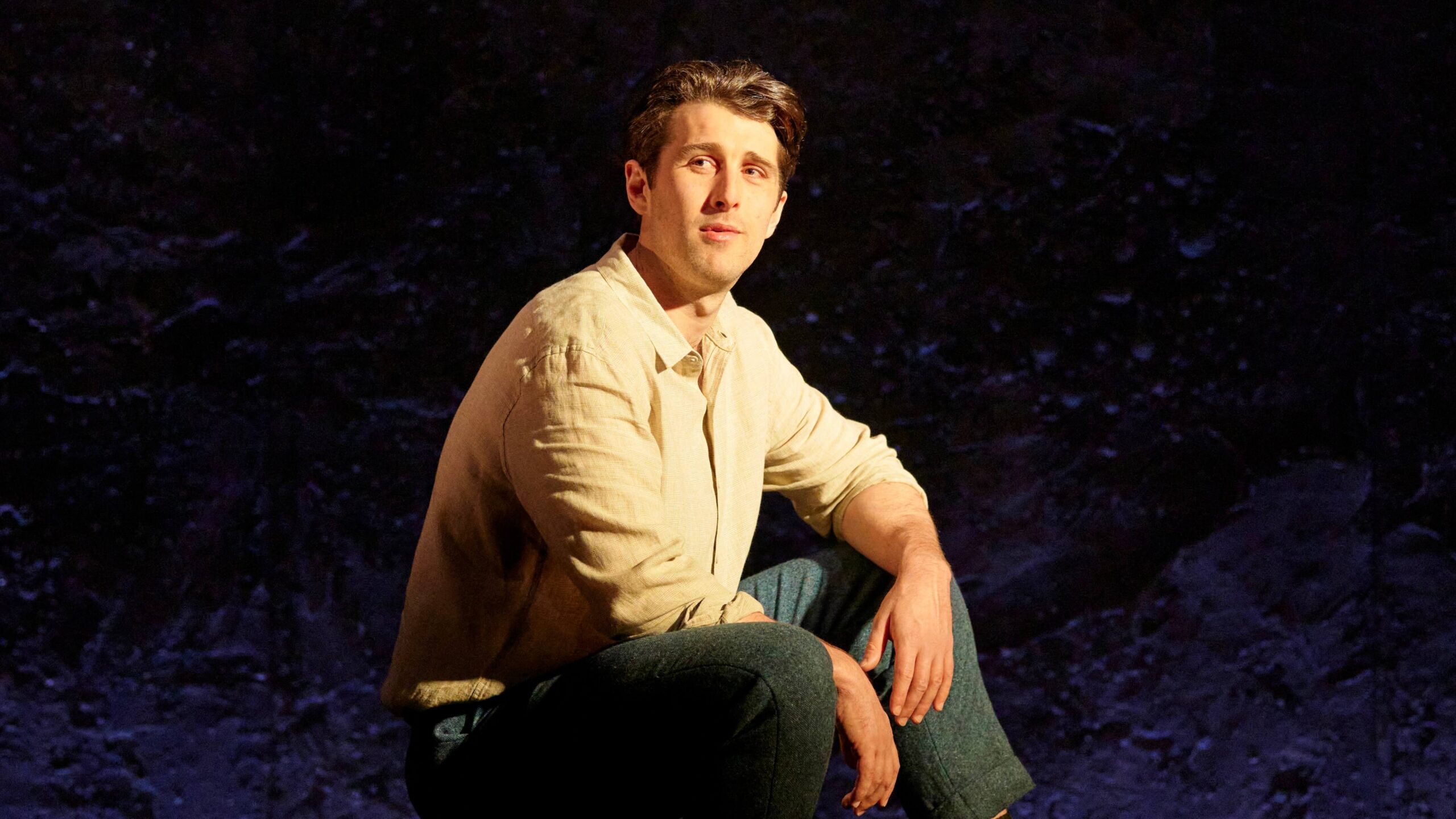
Ryan Donaldson as Man in Do You Come From Gommorah?
P.J. Mathews: Well, I think that’s well articulated and well deserved. There’s no overreaching in that claim, Frank. Can we move from that world to your world now, and particularly to this wonderful, powerful, play. Do You Come From Gomorrah?, which for me, is an extraordinary piece of writing, very moving. It’s a deeply moving play. There’s so much to think about it, but one thing, and I haven’t said this to you … would it be unfair of me to say, in some ways, this play is a very interesting epilogue to Observe the Sons of Ulster?
Frank McGuinness: I’m probably too close to it at the moment to give that kind of precise definition as to what it is. It’s dealing with the loyalist experience, but from a radically different angle, so telling a radically different story. I think there’s no way that I can divorce it from that culture or from that world. But Sons of Ulster was a massive panorama of the experience of loyalism, and specifically of experience of loyalism in the chaos and confusion of World War One, and centering on the horror and disintegration of the Battle of the Somme. This is a very deliberate narrowing of focus. It’s a very deliberate attempt to tell a tale that is meant to unsettle, that is meant to upset, that is meant to record a rage, which I think is still profoundly present in the imagination of Ulster Protestantism. The play took years to evolve. It took a very much longer time than Sons of Ulster did for all its smaller size … years. I couldn’t find a form. It started as a short story and then I realised this is not working at all as a story. I’m not a short story writer. I try … I had a collection, but I don’t find it an easy form, and then it kept changing its title, but it was always one voice. It was always of a working-class, contemporary man looking back on his childhood and his adolescence. It never changed from that, but it did take a torturous route to get it to where it is, and I think that’s maybe because I am confronting certain terrors in my own background as much as in his background. But is it the companion piece to Sons of Ulster? Well, everything is a companion piece to Sons of Ulster. I don’t like the word epilogue because it seems like an ending and at my age I have to be very careful talking about endings … [laughs]. No, I don’t think it’s an epilogue to Sons of Ulster. I don’t think it’s a continuation of it. I think it’s a new imagining of a cultural dilemma and a cultural phenomenon. But I would like to think that it’s not an epilogue, it’s not a beginning, it’s different. It’s its own man. You have to avoid putting too clean a definition on the form of the play. And as I say, it took so long to resolve this form that that’s why I am nervous or reluctant to identify it in certain ways. There’s no question but that certain identities are examined in it that were examined in different form in terms of Sons of Ulster, but it’s a different world, it’s a different history.
P.J. Mathews: Yeah, it’s a different history. And maybe I’m saying that because I see perhaps some elements of the young Pyper in the speaker here, although he’s working class. He doesn’t have the same swagger … but in terms of the contradictions and the forces and the pressures that he has to encounter. But getting back to the form, and I think that’s really fascinating, the form that you found is by reference to the story of Sodom and Gomorrah, there’s so much of the Bible in here. Was that an unlocking of something for you in terms of how the story should be told?
Frank McGuinness: Well the Bible was a crucial influence on Sons of Ulster. My main research for that, and I did a lot of research for it, was to read the whole Bible. And the Bible is the central text of Ulster Protestantism, it’s the cornerstone of that culture. And I really wanted to play with that spiritual inheritance, that literary inheritance, and I didn’t really want to call it Sodom, so the alternative was Gomorrah. And part of me is playing with the whole idea of the tradition in Ireland of the Gate and the Abbey, with Mac Liammóir and Edwards at the Gate and Lady Gregory and W.B. Yeats at the Abbey … you know, Sodom and begorrah [laughs], and that’s a kind of playful reference. I don’t think you can use Gomorrah in the Irish theatre without begorrah … [laughs]. Because this play so rooted in Protestant working-class culture, begorrah really couldn’t be used. So Gomorrah became a good reference for it, with all the mess that Gomorrah involves and the confusion, the whole horror of the history of Sodom and Gomorrah. So that’s where that comes from. It’s the Bible again, as always … me and me pals in the Old and New Testament are riding again [laughs].
P.J. Mathews: Well you know, it works supremely well, even down to the ending where, the speaker escapes ‘caked in salt’ … don’t look back and all of that. It’s really, really powerful.
Frank McGuinness: Well again, it’s me … there’s a contradiction. He does look back and he doesn’t look back. So he gets away though, yeah, he gets away from it, and that’s his liberation.
P.J. Mathews:That’s bringing us to the kernel of the story, which I found really deeply, deeply moving … and that is the will to overcome the malevolent impediments to human becoming and fulfilment, which to me is really what the play is about, specifically the unspeakable suffering of gay life in the repressive darkness of the past. This poor boy becoming a man in the shadows, in abusive spaces, his vulnerability to exploitation and cruelty, and the violent rape at the centre of the play. It is deeply unsettling, as you say, but yet, it is a story of escape and liberation, even though the liberation piece is yet to come. But I found it deeply moving.
Frank McGuinness:There are moments of terrible violence in it. The more I read of the experience of children in education in the 60s, 70s and 80s the more I realise how exposed we were to the insanity of violence. And the treatment that the boy receives is something that I saw myself being done to other people. And I lived in terror. I lived in fear. So I know what it is like to be absolutely cowed by that culture, and that is why I think I use the play as a metaphor for the trauma that I went through and that I continue to go through, and if I have to theatricalise it, if I have to dramatise it by inventing a story, as I do invent—this is a complete work of fiction—then I am still, at the same time acknowledging how difficult it was for me to experience that, and how I live constantly with the aftermath of it. That is why I think it was so difficult to find a form, so difficult to find a story for what I wanted to do in the play. And you know, it was a tremendous eye opener for me to realise that wealth did not protect you in this country, North or South. You know, parents who struggled to send their children to good schools, their children were exposed to this violent madness, and probably they were living lives of deprivation so they could afford it, but it didn’t save their boys or their girls from the horror of what was happening. And a tremendous lesson to be learned for the whole of our cultures, North and South, is that you can’t take your eye off what’s been done to your children. You really can’t, because it was allowed to happen and it was allowed to happen in the South. It was allowed to happen in the North, and the consequence of it is generations of deeply disturbed people.
P.J. Mathews: Well, as you’re speaking there, I’m thinking of the power of the play again, in terms of your decision not to go down the ‘documentary’ route, which you never do in your drama. But it gets back to the earlier point of why this is a brilliant piece of art, because it allows us as an audience to deal with these issues in a way that enables us to transact them and to process them without necessarily being taken on a particular known route or being taken on a particular experience. There’s something much more universal about this, even if it has its origins in a specific experience that’s yours or that can relate or be parallel to other specific experiences in Kincora or in institutions in the South. Again, I’m merely pointing out the obvious, which is the power of this piece as a work of art. And one of the things that I picked up on is, the constant references to the unspeakable: ‘I can’t speak’, ‘my lips are sealed’, and yet the very act of writing this play blows it open in a very cathartic way. Is that something that you were conscious of in the writing process?
Frank McGuinness: Oh I was actually, yes. Again to go back to the point we’re making about The Plough and the Stars, how O’Casey avoids propaganda, how he avoids the documentary, if you like, is that he’s telling many stories. And even though this is a one-man play telling one story, I very deliberately involved as many worlds as possible, as many voices as possible to be communicated through the single voice of the speaker, of the young man. And that way I could tell, if you like, a whole compendium of experiences. That way I could escape from, the restrictions of the documentary or from the realities of history, and go into something surreal, go into something metaphorical, go into something more unsettling. And I want it to be a deeply unsettling play. I want it to be an exposure of something terrible. And I think that, you know, we kind of lost a knack for getting access to ‘the horror, the horror’, you know, and what happens to the child is, is unspeakable. So what are we going to do? What duty do we have? Well, speak about it, defy it, defy them. They wanted to be unspeakable. Those who afflicted this cruelty. They wanted to get away with it. And the only way to stop them getting away with it is to say, I know what happened. I saw what happened. I have a friend, Patrick Doherty from Malin Head, who’s written a book about our experiences of our school called This is Patrick, a very good book about Carndonagh published last year. I’m very proud of the fact that he did it, because, in a way, it kind of released me to do the play. There’s no connection between them, actually, other than our friendship. But it is the fact that people are speaking, the fact people are talking, and this play is a continuation of that outburst. It’s not really a conversation. It’s an outburst of rage, of sorrow, of grief, at what they got away with, but they didn’t get away with it. They didn’t, actually and they shouldn’t have,
P.J. Mathews: Well, it’s thanks to the courage of Patrick and the bravery of your play that that’s actually the case. But changing tack slightly, you mentioned the surreal. There are some wonderful surreal moments in the play, and plenty of whimsical humour in the play. The Ma is a great character.
Frank McGuinness:I love her, I’m glad she’s not my mother [laughs]. She’s her own woman, that’s for sure. She’s certainly got her own fashion sense. I think that is something that people don’t recognise, as a very vital part of the Ulster Protestant tradition … costume and the vivacity of the costume. I know they’ve got the black bowler hats and the black suits, but you’ve also got this extraordinary orange sash. And if you look at the parades, there’s style there, this is a woman of style, and it’s no accident that Jonathan Anderson, who’s the great young designer, comes from Ballymena. I mean, he’s absolutely part of that tradition, and he’s fulfilling what I think is a vital part of his cultural background … exploring colour, exploring clothes, exploring uniform. And I think that that is an integral part of who the Ulster Protestant is. Again, defying convention, defying the sad look that can be put on them. Not at all … they have style, they really have style.
P.J. Mathews: One of the ‘through the looking glass’ moments for me in the play is the story of Keith’s Da in the taxi. It’s an extraordinary moment in the play that takes us, shifts us into a totally different kind of domain. But I think it works beautifully because, given the nature of the of the subject matter, it allows us a space to open new doors of the imagination.
Frank McGuinness: Well, I mean, it’s a very much a working-class play … and working-class culture, as far as I’m concerned, both North and South, but particularly the North, has its bonkers side, it’s wonderful, liberating bonkers side. This story of the father with a hook hand, who might or may not be driving a taxi that’s absolute, you know, par for the course for the world that you’re in here. It’s a great liberation to have that kind of resource, that lunatic outlet, in the middle of all the horrors, and then suddenly to have this, you know, deranged drama, comedy coming through.
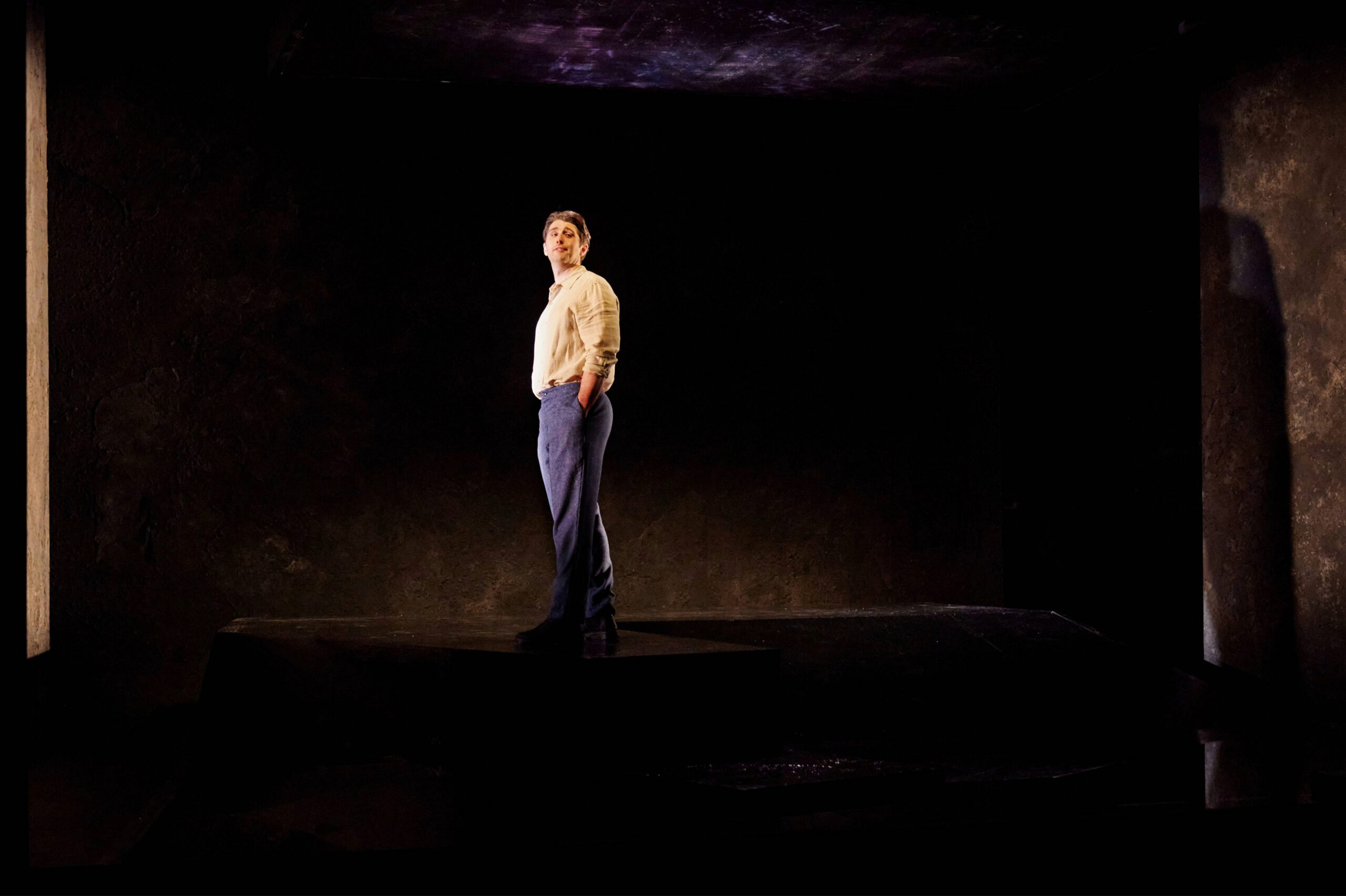
Ryan Donaldson as Man in Do You Come From Gommorah?
P.J. Mathews: And the bejeweled comb, Frank…
Frank McGuinness:Yes, it’s all there, all human life [laughs]. No, it’s meant to be unpredictable, and that’s what I think the wonderful thing about O’Casey is, you know, when you’re listening to The Plough these astonishing metaphors and borrowings. Mrs Gogan’s, you know, macabre imagination coming through, you couldn’t explain it, you couldn’t foretell it, you couldn’t expect it. And O’Casey gives you the right to be unexpected when you’re writing about working class culture, you know, it’s not all grief, it’s not all tragedy. It can be insanity on legs. And I wanted to incorporate that into the play, because that is really what links us North and South, that appreciation of the completely outrageous. I mean, Derry Girls is complete realism, for the love of God, Lisa McGee should be ashamed of herself for exposing us! [laughs]
P.J. Mathews: That’s brilliant … and that takes me to one of the most extraordinary lines in the play, which comes towards the end. I’m going to quote it to you, it stopped me in my tracks, and I just thought oh, my god, that’s an astonishing line: ‘I would like that face to be an egg, so I could smash it, but then I would drink the mess, raw, yellow puss. I would devour it in one go, choking on the shell’. That’s incredible writing, Frank. Does that stand out for you?
Frank McGuinness: Yeah, I don’t know where it came from. I genuinely don’t know where it came from. I knew that that would be a good liberation for the actor, because it’s not anticipated. You can’t prepare to say that line. You can’t suggest it anywhere else. It just has to come. And it should be like a total liberation and revelation to the actor playing it. And the image, I quite deliberately confine images in the play, it’s quite spare, and so when they come, they should be shocking, like the mother dressed in saffron, a brown coat and saffron stockings and shoes. And this image of the egg and the face, it’s such an angry image, and at the same time, such a fragile image, that I felt that that was a good revelation of who the speaker is … fragile, and damaged, and complex, and angry, and ready to break at any minute, but keepin’ going, No, it’s him … that is his line. Only he can say it … and something as strange as that, possibly as deranged as that, is a way of keeping the documentary out, keeping the predictable out. You have to have this shock, and that shock, I hope, is there in the way it’s delivered.
P.J. Mathews: It’s absolutely there … and it just does so much work for the play.
Frank McGuinness: Well, I think it sort of takes it beyond, you know, the obvious and the terrible curse on Irish culture is that we are addicted to the obvious. If we’re not telling pornographic stories about what poor people went through, or if we’re not glorifying the gun, we have to believe in what happened next. Well, we don’t, actually, it’s what happened three times afterwards that we can believe them, and how we get there, is always open to debate, always open for discussion. Nothing is agreed. That’s the one great thing about our stories and our history. There’s no agreement. The Abbey Theatre is what Friel so brilliantly observed—confusion, that’s been its dominant subject, confusion … as Brian writes in Translations, ‘confusion is not an ignoble condition’. I have to agree with him, reluctantly, but I have to agree with him … it is not an ignoble condition.
P.J. Mathews: I agree with you one hundred per cent … the idea and the function of theatre is as much to confuse as to clarify, that is, to unsettle the entrenched orthodoxies, the accepted mores, on all sides of the thought spectrum, and to open up new avenues of perception and discovery of new ways of being in this world. Confusion in this positive sense … that’s a kind of a motif emerging in of our conversation here this morning.
Frank McGuinness: Well, it’s just theatre, the Abbey, the amount of upheaval, the amount of disagreements, the amount of, you know, near closures, the sheer rocky road to Dublin that it has travelled, actually—good! I mean, that’s what it should be doing. That’s what it is. And again, to the credit of the government they haven’t tried to close it—yet! It’s always backed it, because that’s its job. That’s what the Abbey’s job is. More than any other theatre in Ireland. There are good theatres in Ireland, but that’s what the Abbey’s job is. It’s not to provide satisfactory endings, or not to provide safe stories. It’s out there, and really, you know, take it on! And when it’s doing that, it’s doing its job.
P.J. Mathews: There’s another thought that I think arises from this that strikes me, and it’s more to do with the times we live in now, Frank. Sometimes I think that we’ve kind of lost our purchase a little bit in Irish culture on the fantastical or even a playful mischievousness that doesn’t take itself too seriously. We want the easy story, or we want the story where the message is clear, unambiguous. Is that something that you ever pick up on at all? Do you think, we are living in more prosaic times right now? Maybe it’s to do with the social media age, having strongly articulated convictions is fashionable and people tend to dialogue with likeminded folk rather than with people who think differently to their beliefs.
Frank McGuinness: I think that you, you have to remember that there’s still such faith in the story in Ireland, so much faith in being able to convey a yarn and then tell something that can stretch the imagination beyond breaking point. And my proof of that is Jessie Buckley in Hamnet, that second half of the film and particularly the end … where in God’s name did that come from? How could she do that? How could she play that with the way that she does do it, and she’s aided and abetted brilliantly by Paul Mescal. I’m so proud of both of them. But what Jessie Buckley does there, in terms of human contact, only somebody coming from the tradition of knowing how the divine and the human are so savagely, tragically, comically, horrifyingly intertwined, could have played that part the way she plays it. I’m still not recovered from watching that film, and normally I am at a safe distance from film, but this one left me on the seat, shocked beyond belief at what she was able to do. That look, and the look of those around her, it was as if she was transforming the whole crowd and the Globe. And that play, of course, that almighty play that is really my bible, Hamlet, how well she tuned into some savagery that’s there. I had major problems with the way Shakespeare is portrayed, but not with the way she understood, at a terrifying level, what was necessary to convey in terms of grief and how the play is, a terrifying roar of sorrow, and while we have that power, while there’s a woman with that kind of psychic energy coming through our culture … I know she lives in London, she trained in London … but you know that face, there’s the beauty and wilds of Kerry coming at you in that voice. While we have that, we are not indoctrinated, we are not indifferent, we are not controlled. And I think that while those lack of restraints are still operating in Ireland, then all the dangers and worries and rightful griefs and rightful fears about what’s happening in terms of mass communication, or in terms of what’s happening to the earth, we will be able to continue to confront them. That’s a choice that has been made for us by our past. And we can’t escape the past, and we can’t control it. We can, however, understand it, and we can use it, and we can celebrate it, but it’s not an easy choice. And nothing is easy about Ireland—never has been, never will be. And we have to be aware of those who might tell us otherwise, but we live in a hard place, and we’re facing a hard future, but we have the means, and we have the gumption to get through.
P.J. Mathews: All the more reason why we’re so lucky to have artists like yourself to help us along the way …
Frank McGuinness: … or eejits like myself … I think my family would be the first to correct you there [laughs].
P.J. Mathews: No eejits, no eejits, Frank, absolutely not [laughs] … well I know the word eejit is used once in this in this play.
Frank McGuinness: Oh, absolutely, yeah, the word eejit is used in every play!
P.J. Mathews: Frank, thank you so much. It’s been a pleasure, thank you.
Frank McGuinness: Thank you, P.J.
—
Frank McGuinness is an award-winning Irish playwright, poet, and novelist. Born in Donegal, he is Emeritus Professor of Creative Writing at University College Dublin. His adaptations of classic works have been widely acclaimed, with his version of A Doll’s House winning both a Tony Award for Best Revival and the Outer Critics’ Award.
Theatre credits include Dinner With Groucho at The Civic Tallaght, Greta Garbo Came to Donegal, There Came a Gypsy Riding at the Almeida Theatre, Speaking Like Magpies for the Royal Shakespeare Company, Mutabilitie at London’s National Theatre, The Hanging Gardens, Dolly West’s Kitchen, Someone Who’ll Watch Over Me, Observe the Sons of Ulster Marching Towards the Somme, Baglady and The Factory Girls at the Abbey Theatre. He has also adapted classic works by Chekhov, Brecht, Ibsen, Joyce, and Oscar Wilde.
His screen credits also include A Song for Jenny, A Short Stay in Switzerland, The Stronger and Brian Friel’s Dancing at Lughnasa.
P.J. Mathews is a Professor of Irish Literature, Drama and Culture at University College Dublin and Director of the UCD Creative Futures Academy. He is the author of Revival: the Abbey Theatre, Sinn Féin, the Gaelic League and the Co-operative Movement (Field Day); co-editor with Declan Kiberd of Handbook of the Irish Revival (Abbey Theatre Press); editor of the Cambridge Companion to J.M. Synge, and Executive Producer of the feature documentary, In Time: Dónal Lunny (South Wind Blows Productions), which premiered at the Galway Film Fleadh in July 2025. Prof Mathews previously served as a Naughton Visiting Professor of English at the University of Notre Dame, Academic Director of the W.B. Yeats Winter School in Sligo (2017-20), and the Parnell Summer School in Avondale (2002-05).
Photo credits from Do You Come From Gomorrah?: Ros Kavanagh
Do You Come From Gomorrah? runs on the Peacock Stage until the 16th of May.